
Soo Line Events (1894)
[ sources ]
Gary Entz
ANMiH is an ongoing exercise in public history which was written and performed by Gary R. Entz for nearly four years beginning in May 2018. The radio shorts appeared on the Rhinelander community broadcasting station WXPR. The early majority of these scripts were funded by the Wisconsin Humanities Council and compiled and published by White Pine Community Broadcasting in 2021. Dr. Entz is from Salida, Colorado with degrees from James Madison (M.A.) and Utah (Ph.D.). The bulk of his academic work appeared in the Kansas Historical Society journal. His articles and book are broadly about the American west, colonization and religion. From "Pap" Singleton, the Llewellyn Castle and Mormons in Kansas--Entz recreates the daily frontier life and internal migrations of utopian colonizers. Entz is a published expert in a field with Horace Greeley, John Brown and Joseph Smith as guideposts. One critique of ANMiH is the absence of regional equivalents like the Wisconsin Phalanx or King Strang. Maybe Ceresco (Ripon) and Beaver Island are outside of the show's geographical parameters but they seem like logical extensions of Entz' scholarship. Some of Entz experience, such as on Native American culture, does inform the radio and print editions of ANMiH. He is talented at contextualizing local events using national periods. For example, a story about the local Rouman drive in theater was also about energy resources, social independence, technological advancements, Hollywood and the automobile age.
Regardless of similarities in theory and sources, ANMiH's public history and Entz' peer-reviewed oeuvre are of different methodologies. ANMiH doesn't have a bibliography and there are no sources. One can assume that much of Entz' sourcing leads back to the state Historical Society archives in Madison, county archives like that in Wausau, town historical society archives in Minocqua, Rhinelander and Three Lakes or library collections like T.B. Scott's history archive in Merrill. There are certainly some Moments that rely on the WXPR collection. Without sources, who knows?
There are regularly cited is photographs which accompany online versions of articles. But even these citations are generic "WHS" without links or collection data. The lack of photo citations or credit is the convention for the KHS' Kansas History journal as well. This is not the case for text citations. In his peer-reviewed oeuvre, Entz university presses (KS, NE, Temple, N. Illinois), peer reviewed journal (agriculture, religion) and relevant popular secondary (including Thomas Frank!) sources. His most cited primary sources include letters, testimonies, old histories, personal accounts, news papers, handbills, maps and speeches. The rigor and value of his academic work is described by the footnotes (and credentials).
State Media
Doing public history on the radio is a different skill. Public radio in Wisconsin started broadcasting on 9XM from the UW in 1914 as part of the broader Progressive Era Wisconsin Idea intermingling of the university and politics. BBC Radio provided a national framework for the Medium in 1922. Two classic BBC features Letter from America (1946-2004) and From our Own Correspondent (1955-present) are models of American cultural studies which are standards of the BBC format.
The BBC World Service was founded in 1932 as the international arm of British state media. The American model separates the international and domestic brands. FDR spoke to a domestic audience in his Fireside Chats. The Voice of America was founded in 1942. NPR and PBS were funded by the LBJ era Corporation for Public Broadcasting. XPR and thirteen other NPR affiliates were founded in NPR dead zones 1980s. A the WBEZ version of the BBC American studies programs is This American Life which was first released in 1995. The topically general and WPR University of the Air and interview shows (some former hosts: Tom Clark, Jean Feraca and Glenn Moberg) cover Wisconsin cultural history. The recent NPR history program Throughline is hosted by Americans of Iranian and Palestinian heritage. In this last case the domestic political power of state funded cultural history is most evident. But the same is true of Latino USA, Native News Now or Route 51. The implications of state radio are more obvious in international contexts like the VOA. But the same state-sponsored political narrative is created and reinforced in at WPR, BBC, VOA, NPR and PBS--the medium and message are the same, only the style is tweaked.
There is nothing nefarious about the smaller message discipline or broader narrative control. An "official narrative" is like fiat or an army--something only the state can muster. Creting programs like Frontline, Sesame Street and All things Considered is one of the best reasons to pool money together as a society. But there are certain fundamental stories that undermine the state narrative which must be difficult to cover from within.
ANMiH is a state sanctioned public media of a type which favors hagiography to subversion. That doesn't mean it can't be used to promote progressive change. Mr. Rodgers famously soaked his feet with Officer Clemmons on 9 May 1969 in support of racial justice. Dr. Entz, a navy veteran, might not have the counter-cultural cache of Mr. Rogers but he certainly reins the medium to critically evaluate Wisconsin's native treaties. Entz self identifies with social history tropes "his goal is to approach history from the bottom up," explore the lives of "ordinary people" without retelling stories of "rich, famous or politically connected" people. Entz is doing a community history of "individuals, families, and organizations." He uses these small social units to tell a narrative about "how society changed over time." Some ideal versions for this type of social history are Studs Terkel, Michael Harrington or David Kyvig.
A Northwoods Moment in History
The print edition of ANMiH is divided into nine chapters. Two of these chapters, daily life and first nations, feature social history about making syrup, ice fishing, downtown life, local Hoovervilles, and a profile of a cow. Other parts of these two chapters are about the bourgeoisie rules based order including treaties, allotments, parking meters and diplomats. Five of the other chapters on industry, wartime, transportation, crime and famous visitors are thematically histories of national chauvinism, law and order, industrial development and celebrity culture. Some of these are more public histories that they answer local questions like: "Why are the Rhinelander Smokestacks Missing the Letter "G" in Glassline?" The remaining two chapters on special events and town origins are also of this public history theme where ultra-local questions are answered.
The upper Wisconsin river was both a transportation route and method of powering the mills. Wisconsin River towns like Rhinelander, Tomahawk, Jenny Bull Falls (Merrill) and Brokaw were settled at places on the river that could be dammed. From upstream the lumberjacks sent logs downstream to these towns. The logs were sorted in log booms on the artificial lakes--or flowages--which powered the dams. The dams ran the saw mills. The milled lumber shipped on rail roads or river barges onto the national and global markets.
This neoliberal narrative ends before the consequences of extractive industry are paid. The Wisconsin River is part of a prehistorical trade network that connected the Great Lakes to the Gulf of Mexico. The river imported Catholicism and exported pelts during the French period. After the Americans claimed it from the British they built forts at Green Bay, Portage and Prairie Du Chien. From those forts they cleared the native populations in a series of wars ending with Black Hawk. After that time, the river imported Yankee and European settlers and exported lumber. The Yankees built the Ontonagon trail to export copper and the Soo line for wheat. They furnished the ports with ore docks export iron. Along the way they also built a postal system, schools and libraries. Market conditions have changed, there is not enough demand to keep the forests and the mines in boom time. Without exports, the railroads have been torn up and the ore docks demolished. In some cases, like Ladysmith, the industries contaminated the drinking water before leaving town.
Al Gedicks
Al Gedicks, UW-La Crosse emeritus professor, has been writing about the similarities of extractive industries in the Global South and the American periphery for years. His worldview demands solidarity and vigilance among those who live among natural resources from South America to the Flambeau Mine. First nations and Wisconsin people have recently organized against proposed sulfide mines that would affect the Wisconsin, Bad River and Menominee River watersheds. Through Gedicks' framework, the Ontonagon trail roadside marker "In 1864 Abraham Lincoln commissioned this road extending from Green Bay to Fort Wilkins as a Military Highway to secure copper supplies for the Union Forces" can be read with a sense of resource exploitation and imperial intrigue. Lincoln the resource thief is a hard story to tell on public radio. Even the laudable This American Life episode "Little War on the Prairie" about the period features Lincoln the Imperialist in the war against the Dakota. The historian, Gwen Westerman, is telling the Evan S. Connell-Dee Brown story about federal government and the Indian wars. The shocking part is putting Lincoln there.
Gedicks internationalist version of resource solidarity shows that the same resource exploitation process is playing out in the same way regardless of national boundaries. Survey, parcel and Indian removal are three things that happen before the resources are extracted. This is the same in the Northwoods or Amazon. That moment between surveying a value and removing the people who lived there--where common frontier range becomes a territorial parcel is the moment social change that no state run (or private) media company could address. This is because they are funded and regulate by state and private capital.
Entz, while telling the same story, starts with the Indian removal in 1836 and the founding of Wausau in 1852. Entz' version of federal overreach is based in the Jacksonian state and the Indian Wars. Entz uses treaties, businesses and town foundings to tell the story that Gedicks tells through resource deposits and social movements. Entz describes economic imperatives of navigation, the availability of land due to Indian removal, explains colloquialisms (like bull falls), and traces the historical trail through modern towns that his listener will recognize. They are telling the same story of public and private cooperation in the economic development of the region. Gedicks tells the story because he wants to build international solidarity against global extractive industry because of the environmental destruction it causes.
Entz' "Moments" don't have that same call-to-action, maybe because of FCC rules. Instead a story about "The History of the Bearskin State Trail" (26 September 2018, pg: 259) uses language like "sceninc...recreational attraction...tourist destination" which could have come from any state park or chamber of commerce advertisement. The Bearskin Trail narrative continues describing the Wisconsin Central train line built on trail which "exist[ed] long before any railroads or logging camps were in the area..." The macabre part of the story is ignored.
Jones/Mcvean (1923)
The part of the Bearskin Trail narrative that is missing is about Indian mounds. Jones/Mcvean (1923) cites Wisconsin Archaeological society surveys along the Wisconsin River Valley in Cassian and Heafford Junction (maybe also Bradley and McCord) where "large groups of Indian mounds" existed. This could have been an earlier settlement that would become McCord Village. Another set of mounds near Lake Tomahawk has been turned into a campground Wisconsin DNR. When Entz describes the history of Lake Tomahawk, he starts with the removal of an Ojibwe village as the railroad comes through in the 1880s. The burial mounds are not included in the narrative. Depopulation strategies from germs, war and starvation are also absent. The state-sanctioned privately-financed transition of land into property is what created value in the Northwoods before any surplus value could be extracted from laborers.
Jones/Mcvean are most clear when they describe the railroad graders in 1888 Minocqua, who "unearthed quite a number of bodies..." of Native Americans who used to inhabit the region that were unearthed. The pioneers told stories of time "not very long ago" that "bones could be seen sticking out" when they cut rail road grades through burial mounds. A charitable explanation would include the swamps of Lincoln county notorious for swallowing train tracks and cars. The mound builders and railroad graders both looked for flat dry land among the muck. The railroads were built with fill from and atop burial mounds.
There are less charitable ways to explain the literal Indian burial ground beneath much of the Northwoods. Since the 1970s, historians like Howard Zinn, David Stannard, Jeffery Ostler and Roxanne Dunbar-Ortiz have emphasized the quantitative body count of European contact. In this case, hastily burying all of the victims of the small pox epidemic of 1837 would result in lots of bones eroding out of hillsides in the 1880s. There is a cultural form of erasure that also happened. Dynamiting burial mounds is cultural imperialism like Mt. Rushmore (1927-41) or Indian boarding schools.
Inter-tribal warfare is another product of European contact. The Oneida who came to live in Green Bay were displaced by Dutch and Anglo settlers. Looking for new land and armed with European weapons and shifting political alliances with France and England they moved west along the Great Lakes where they were in conflict with tribes they contacted. This population pressure pushed the contacted Great Lakes tribes, like Wisconisn's Potawatomi and Ojibwe, to the western edge of their traditional territory. This land was already claimed by the Minnesota plains people like the Dakota and Sioux. In the Northwoods the conclusion of this post-contact tribal redistricting happend on Straweberry Island in 1745.
Entz' history of Lac Du Flambeau and Strawberry Island (23 January 2019) is an example of the immediate violence of war. Through his historical lens we can see the island as a 2,000 year old burial ground and the site of a decisive battle and an anti-allotment symbol that is promised to become tribal land in the future (See: Mills family and Medline Industries). The fact that humans have been buried on this island for two millennia makes it "one of the most important historic sites in Wisconsin..." The artifacts, dead bodies and historical narrative are what kept the non-tribal owner of the land from completing his plan to turn it into condos.
Sticking with the charitable example, the swamps of Lincoln and Oneida counties swallowed fill. Without fill, the tracks, trains and cargo were also destined for the bottom of the swamp. The burial mounds were not built on the swampy places and may have provided elevated land and convenient fill for the railroad grade. If this is the case, the Department of the Interior is empowered, but not compelled, to repatriate the graves under the Bearskin Trail, the Island City and Indian Shores Campground. Natives may have ceded the land in treaties but the literal bodies underneath that land belong to them. Whatever repatriation looks like in practice, certainly grading burial mounds into fill for railroads and recreational trails has to account for the bodies just like Strawberry Island.
Entz' version of social history can cynically be used to sell trail passes by downplaying the macabre. It provides a place of belonging and serenity at the expense of some realism. Every rural community has a discovery story, first business, infamous criminal or recurring event. A Ph.d like Entz could take his "familiar[ity] with rural culture" and historical periods and write the same series of essays about any small town in America by changing a few dates, surnames and place names. Methodological and theoretical explains the differences between radical internationalists like Gedicks and bourgeoisie liberals like Entz. There is a critical place for both methods in Progressive media.
Lydon (1949) and Corporate Histories
Different events read differently to different historians. What is acceptable and interesting also changes over time. This is why Entz' Bearskin trail narrative is about recreational opportunities (and not disinterred graves.) And his Ontanagon trail narrative is about Indian removal, the Dawes Act and allotment (and not about Civil War armaments). This is not a comment about the truth, only the political uses of historical language. Jones/Mcvean and Gedicks are not good quotes for a travel guide. Entz would be more useful to businesses and underwriters. The highest return comes from corporate histories commissioned and produced in house.
For example, a 1949 article in about the Soo Line railroad in the Escanaba Daily Press. The article describes a meeting of the Gladstone (Michigan) Rotary club. The featured guest was Jim Lydon, the Minneapolis based Assistant General Passenger Agent for the railroad. In attendance were a "group of railroad officials" including superintendent A.C. Peterson who was "in charge" of the meeting. First, Peterson described the "Diselizing" of the line to be completed later that year. Then came Lydon's history of the line which was part of a "prepared talk" which the EDP excerpted. This is the corporate history, told at a board meeting to officials.
The Soo line was organized in 1883 and started to build from Minneapolis to Turtle Lake and eventually reached Pembine and Rhinelander. It was initially referred to as the Sault Ste. Marie line because that is where it's final destination was. By the time it reached Gladstone it was called the Soo line referencing the Soo locks which were completed in 1855. Most of the Gladstone-Rhinelander segment was completed in 1887 and the end of that year the Soo and Canadian Pacific "were joined."
The first train load of "105 carloads of flour" departed from Minneapolis a week later. By summer of 1888 there were "sleepers from the Twin Cities to Montreal and Boston" that ran until World War I. Of particular interest to the assembled Rotarians was the building of the Gladstone "Lake Terminal" and post office. After that came the station, machine shops, coal sheds, roundhouse, and two ore docks.
From Gladstone, via Little Bay de Noc, the railroads could import coal and Minneapolis grain could be shipped to Great Lakes ports like Buffalo. According to Lydon, Gladstone once had the "largest flour docks in the country" and "was equipped for coal, iron, timber flour and merchandise." The company town of Gladstone, north of the much older Green Bay port city of Escanaba, was "a complete new city containing everything to enable it to compete with all other lake ports."
Lydon continues, "financing and building project worthy of later times." The railroad continued to invest in their Lake Michigan port by rebuilding the route from Minneapolis using heavy rail in 1890. The port expansions continued until the "large merchandise dock...flour shed and the original coal dock" burned down in 1891. They were rebuilt, larger, the next year along with a new grain elevator and "power house that had a brick chimney 130 feet high." At its largest, the Soo line connected the Dakotas, Winnipeg, Duluth and Central Wisconsin to Gladstone, the Soo Locks, Montreal and Boston.
The necessary and predictable decline part of this narrative is anathema to corporate histories. To Lydon, the corporation is the obvious unit of study and they were building an infrastructure for the future. Lydon centers the national corporation as his main character. This is different than Entz' local person or Gedicks' international movement. Centering the corporation avoids questions that Entz and Gedicks could ask. These would have to include native depopulation, land grants, resource capture and worker repression and the federal reinforement of corporate capitalism and the free market. This story is outside of the scope of the Escanaba Daily Press and the assembled Rotarians.
To his credit, Lydon does address a critique of this sort concerning the difference between land grant rail roads and private rail roads. The former is chartered by a government while the later (like the Soo Line) "purchased all of its right-of-way" as private real estate contracts. The more radical critique concerns how the communal land that existed before European contact was transformed into private property through surveys, depopulation and allotment. In a corporate history this is all a precondition for the corporation so it is ignored by Lydon.
The bust part of the Lydon's narrative also centers the corporation. The railroad declined after 1923 when the "great forests" were exhausted, lakes shipping ended and the "mills dismantled." What was left were "ghost towns."
It seems like the railroads facilitated the removal of most of the regions natural resources. The rail road executives believe that their commodification, extraction and exportation for profit was a benefit to the community that had their resources extracted. The accumulated capital: railroads, factories, mine shafts, ore docks that help export the resources are "investments" in the future. But that future will only exist under the right market conditions.
Lydon doesn't see the corporation as the entity that privatized, cut down and shipped off the Northwoods. Instead, the corporation is "still there waiting to serve" when it becomes profitable. He explains how technological advancements in flour milling, the end of "free lands," and end of the forests have made the Soo line unprofitable in 1949. Instead of reflecting on the Manifest Destiny boom time, Lydon laments New Deal Era regulations.
He blames "Laws [that] forced them to keep...operating and open," "fixed" rates, regulation "in everything by commissions of the states...and by the Interstate Commerce commission." Blaming interstate commerce protections for the failure of the railroads is a strange historical take. The ICC is the established federal mechanism of breaking rail unions and compelling work without contract used from the Gilded Age to the Biden administration. Interstate commerce is the concept that ended the Pullman strike of 1894.
He is trying to have it both ways by protesting federal regulation and also profiting from the stable market conditions it provides. Lydon claims "Railroads are public service companies..." by which he doesn't mean they deserve special regulation. What he means is "selling of railroad services differs from all other kinds of selling..." Railroads should be protected by the federal government against the workers. But any other public regulation would violate lasseiz faire economics. In American history this is a common conception of public transport fromtne Great Railroad Strike to Pullman to PATCO.
The Pullman Strike ended two and a half months before the Soo Line events. There is no proof that the Chicago based strike influenced Paflinski and Hazelton but there was prolonged national violence and a national Darrow for the defense campaign on behalf of Debs who was charged with conspiracy. It is unlikely that Paflinski and Hazelton wouldn't have known about Pullman during the Soo Line events. It is unsurprising that Lydon doesn't talk about either Pullman or the Soo Line crash of 1894 in his presentation.
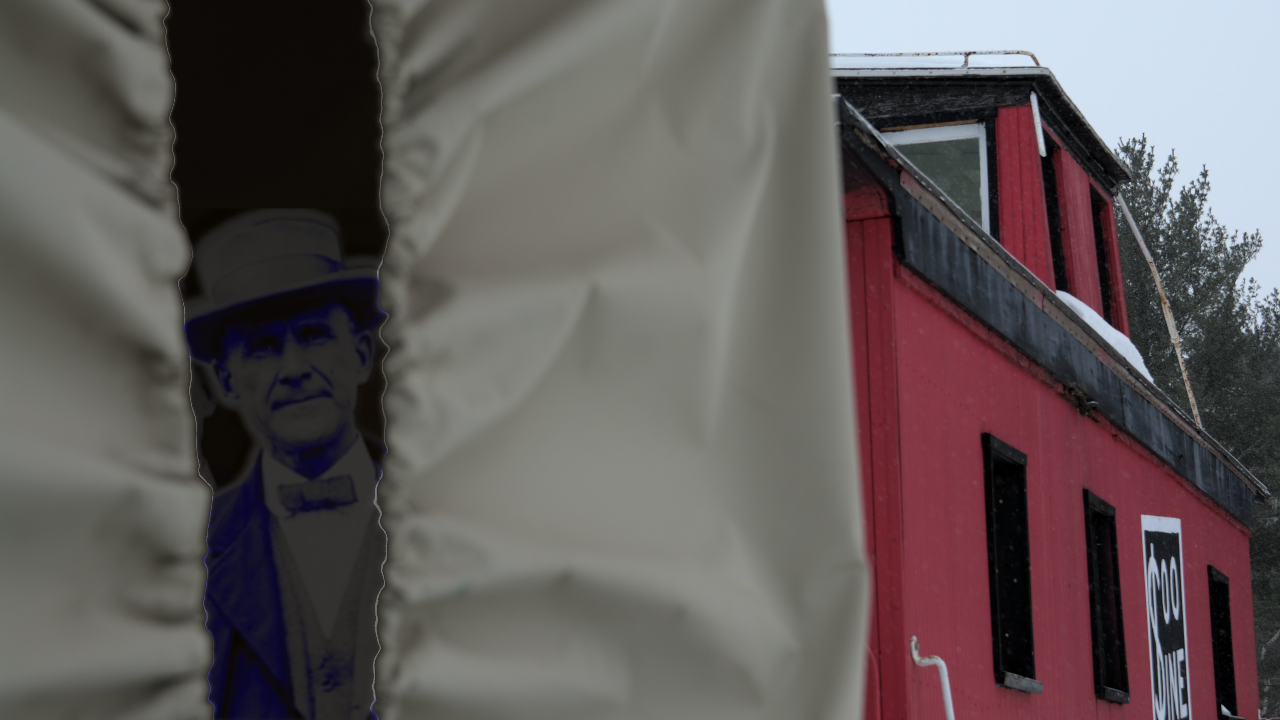
Soo Line Event (1894): Entz Framing
Entz' combined Soo Line narrative is different from Lydon's but it is also missing reference to Pullman. There are nine ANMiH that describe the rail road including "The Bindlestiff Who Hopped a Train North" (15 June 2018, pg: 35), "The First and Last Soo Line Passenger Trains" (17 April 2019, pg: 263) and "1894 Train Robbery Turned Tragic Accident in the Northwoods" (22 September 2021, not in book). The first of these three is about Frank Lamperer a hobo from Green Bay who "decided to hop a Soo Line train" only to be "dislodged...from his perch" onto the tracks and was "struck repeatedly" by the train cars as they went by. He "dragged himself" to Rhinelander where "charitable individuals" took him off the street and into a hotel and provided a doctor. The second ANMiH explains "the company was primarily a freight railroad" but there was regional passenger service. This is very much like the corporate history from Lydon and it describes building the "depot, watertank, and roundhouse." The first passenger train toured the line in 1886 carried "railroad representatives" who were "welcomed by a civic committee, a band and a crowd of several hundred people" and attended a party. Passenger service was discontinued in 1960 with much less fanfare as the westbound No. 7 went through with only a handful of passengers.
He also covers an event from 7 October 1894 when a "20-foot-long trestle north of Tomahawk between Heafford Junction and Bradley" collapsed as a westbound train derailed as it crossed "moving at a relatively slow speed." As the locomotive and cars rolled down the embankment Engineer James Dutch was tossed out and injured. Fireman Charles Cottrell was "caught beneath the falling locomotive and crushed to death." These were the only major injuries.
A train was dispatched "carrying a doctor and a railroad detective." The scene that Entz described when they arrived: "Someone had taken a saw and cut through the timber stringers and braces supporting the railroad ties. With those cut, the only thing holding up the entire trestle were the rails themselves, and that could not support the weight of a train." A similar set up had been discovered in Prentice the week earlier. Entz describes this as a "death trap." In this early part of the story--the stringer cutters have no motive. This is not a "prank" and it made people "outraged."
Two men, "Levitt Hazelton of Brainerd, Minnesota, and Frank Williams, alias Paflinski" are placed in Rhinelander the day before the crash. Four days after the crash Sheriff Patzer got a telegram from a "station agent informing him of two suspicious-looking characters skulking around the area." Patzer jailed "the two heavily armed men" on "concealed weapons charges." This was a pretense to keep them under observation while a case was built against them concerning the train crash. The men were held for more than two weeks while the investigation proceeded. Hazelton "confessed" in the face of "evidence mounting." The evidence is never described by Entz. The plan which Hazelton describes "had been to cause a high-speed wreck where everyone would die. With no witnesses, they would rob the safe in the express car." When they failed to murder everyone on the train they got scared and ran away. In Entz' retelling "Hazelton and Williams were convicted of murder and sentenced to the state penitentiary."
Soo Line Event (1894): Radical Framing
To better understand this event requires an introduction of some supplemental sources. The first compares Civil War train saboteurs to Gilded Age train robbers. There is a similar anti-federal sentiment in confederates, natives, and frontiersmen. This is a sentiment shared with anarchists like Lucy and Albert Parsons. Parson's "A Word To Tramps" was published in Chicago a decade before the Soo Line Event and her version of anarchism was (along with Debs version of socialism) influential in the run up to Pullman. Parsons' manifesto was addresses specifically to guys like Hazelton and Paflinski (or perhaps Ben Reitman). Hoboes have a cultural history that includes Parsons, Dr. Reitman (and his friend Emma Goldman), Progressive era sociologist Nels Anderson and modern writers like labor-gender historian Higbie and social historian of homelessness DePastino. and Progressive Era urban studies sociologist Nels Anderson.
During the Civil War it was common for irregular confederate militias in border states to sabotage Union infrastructure. For example, the O&M train collapse in Southern Indiana. Compared to to Gilded Age train robbers like the Reno and Hole in the Wall gangs--who targeted physical loot in the mail car and on the passengers--the O&M attack was an act of mass murder. The Gilded Age train robbers limited the body count and focused on the loot.
This matters in terms of extraordinary punishment, of the 115 ESPY File executions from 1894: 109 were for "Murder" and twenty eight were for 28 "Robbery-Murder" and no one was executed for robbery alone. Of course, Wisconsin doesn't have the death penalty but it is still a deterrent. First, killing somebody while doing crime against interstate commerce or the postal system is a Federal offense. Second, Paflinski's relief was observed by the press when his prison sentence was read and it is suggested he was expecting to be hung or electrocuted.
Ashbaugh's classic biography of Lucy Parsons emphasizes her membership in three underclass communities defined by gender, race and class and advocacy for free-speech, against hunger and poverty. One mechanism that the elites used to delegitimize her demands was "portraying [Parsons] as a criminal...to direct public attention away from the real issues..."
Jones' biography of Parsons emphasizes her life outside of her husband (executed in 1887 following Haymarket) as a radical provocateur for worker rights and free press advocate who exhibited personal contradictions regarding race, wealth, status, sexuality and established law. Described by Jones is her "deep commitment to informed debate and disqusition, on the one hand, and, on the other, an unthinking invocation of the virtues of explosive devices." The disconnect between theory and deed is a problem for Albert and Lucy Parsons, Alexander Berkman, Goldman and Reitman. Jones comments on the irony of the period's doctrinaire anarchist critique that was only possible under a rules-based free-speech order.
Jones' Parsons survived in limimal spaces like "indeterminate" race, public personas, media narratives, press because of personal and generational trauma based in slavery, the Confederacy, masculinity and capitalism. Ashbaugh's public biography and Jones' personal (and disposessed) biography both describe Parson's provocation in Alarm to "learn the use of explosives!" It advocates tramps learn how to destroy infrastructure in order to end capitalist exploitation. Parsons' broader underclass appeal was meant for migrant labor (hoboes), migrant unlabor (tramps) and unmigrant unlabor (bums). It is safe to assume that Paflinski and Hazelton were familiar with Parson's appeal. Like Parsons, Paflisnki had an unsettled childhood bouncing around the midwest. Maybe this dislocation and appeal to arms can explain the "heavily armed" men taken into custody near Irma and, according to Entz, charged with concealed weapons. The train wreckers gave up without firing a shot.Soo Line Event (1894): Synthesis
Established passenger and commerce lines are attractive to criminals because they represent concentrated wealth on predictable routes, cutting edge technology moving through unpopulated geography. Parsons participation in liminial gender, race and national spaces should also include tramp liminalities which confuse mechanical, natural, urban and rural concepts. Seasonal farm labor that travels on industrial railroads is facially anachronistic a concept as black, confederate labor leaders in Chicago.
The Soo Line was made up of concentrated capital from Minneapolis, St. Paul, Montreal and Boston. On the tracks in the middle of the Lincoln County this capital was exactly the same as it was in Minneapolis and Boston. The difference is that it was not surrounded by the rest of the city--banks, police, Pinkertons, journalists or onlookers. The easiest and most profitable place to rob city wealth is as far away from the city as possible. In this case they even run on a schedule.
With such a vulnerable infrastructure, during a period of intense rail unrest it would make sense to frame the Soo Line events as robberies gone wrong and not part of an anti-federal sabotage campaign that had been happening since the Civil War. During this period Anarchists like Parsons were strategically deligitimized by the press. The Northwoods press was unabashed when quoting corporate histories verbatim.
When a radical act is framed by complicit media to fit the corporate narrative it loses meaning. Anarchists like Berkman and Goldman believed the propaganda value of the deed had revolutionary implications. It is obvious that this was the plan during the Frick assassination attempt. Propaganda of the deed is a legitimate place to start when studying the motivations of an Anarchist. Some cases like Leon Czolgosz (McKinley) are anarchistic and others like John Schrank (T.Roosevelt) are insane. The chronology of American type of revolutionary vigilantism start Shays' Rebellion and John Brown's Raid. The media coverage after the fact is what determines the propagandisic value of the revolutionary act.
Jennett Blakeslee Frost The Rebellion in the United States describes the O&M Event as "Another railroad disaster" on Sptember 17. Irregular and guerrilla warfare is standard for Confederates who didn't care how their "enemies were destroyed, whether by fire, by explosions, by poison, by submarine batteries, by railroad accidents, by ambuscade, or at the cannons mouth on the field of battle..." The O&M Event was "another bridge destroyed" this time near Huron, Indiana. On this train two hundred and fifty union soldiers on their way to fight in West Virginia "precipitated down into" the creek bed because the bridge abutments were cut. One hundred soldiers were killed or wounded.Frost describes at least six instances of trestle sabotage during the civil war. An expected train never arrived and it was found derailed two miles from the Junction because "between the time the train passed up and its return, some of our gentle friends in Maryland had torn up a rail..." The "splendid" B&O bridge across the Potomac was burned by Confederates from the northern end and dynamited from the south. Sabotage on the North Missouri railroad set up an ambush "from the woods, where the rebels, after tearing up the track had secreted themselves." A reconnaissance mission of the Illinois Eleventh regiment to "prevent the enemy from burning the trestle work on the railroad near Charleston." The Platte River "catastrophe." The bridge was one hundred feet long and thirty-five feet high. The bridge was burned until it almost collapsed and the fires were put out. There were ninety people (men, women and children) aboard when it crashed and only three weren't hurt or killed on impact. Targeting civilians in passenger coaches makes Platte River particularly terroristic. This is a characteristic it shares with the Soo line event thirty years later. The last of these escalating attacks on union train lines is the "deep-laid plot" that sabotaged an O&M trestle near Huron, Indiana.
The trestle was also exploited by Hole-in-the-Wall Gang. They didn't maximize the body count like Confederate saboteurs during wartime. Instead, they damaged the trestle to separate the engine and passenger cars. This facilitated a robbery of the mail car without putting the civilians at risk. The Soo Line robbers damaged the trestle in front of a moving train. This is more like Civil War era irregular warfare than Gilded Age highway robbery. The civilians aboard the train make it seem more Platte River then Huron, Indiana.
Dobson's "Wyoming Tails and Trails" documents the train robbery era and the Hole in the Wall Gang. They targeted frontier banks, trains and stage coaches. When the Montpelier bank in Idaho was robbed the men hid their faces while an accomplice tended get-away horses. When the Pleasant Valley Coal Company was robbed it took a week of surveillance to target the payroll car. The robbers cut the telephone lines. The 1899 Wilcox Robbery started with a barricade across the Overland Flyer tracks. Masked men boarded the train and separated the express car from the passenger cars. The blew up the trestle between the two cars and the safe inside the express car. There is a method to train robberies. Paflinski and Hazelton were doing something different and it resembles Civil War era irregular warfare.
The Soo Line event happened somewhere between Heafford Junction and Bradley north of Tomahawk. The 1895 plat of the region shows Bradley as a six block town. Heafford Junction is just a station at the intersection of the Soo and Hiawatha of the Milwaukee Road. Paflinski and Hazelton were found wandering the Hiawatha near Irma after destroying the Soo.
The Hiawatha first served Tomahawk in October 1887 according to Burg and Storozuk. This line followed the Wisconsin River Valley north-south from New Lisbon to Tomahawk. The railroad turned north at Tomahawk when the river went East towards the river's headwaters at Land O' Lakes. The Hiawatha ended at the Boulder Junction/Star Lake lumber camps.
The Soo was originally a flour freight line from "the Twin Cities for eastern markets over the short route" to Rosholt. This route included Wisconsin and Michigan and connected with the Canadian Pacific at the St. Mary's River bridge at Sault Ste. Marie and named for the Soo Locks there. The scale of the railroad increased through mergers with competitors until it was 737 miles "in the wilderness" between Minneapolis and Canada. Rosholt cites volumes from the Soo line Railroad Company (1955, 56) and the Soo Line Historical and Technical Society (1984). This all echos Lydon's well maintained corporate narrative from the 1940s. To Lydon, The Soo Line's mission "to break the fetters of the Chicago gateway to the East [and] make the small city of Minneapolis the world's largest flour milling center." This is essentially the same thing as Rosholt.
Paflinski and Hazelton were convicted of the robbery turned into murder. The crime that went untried was compromising the world's largest supply in transit to north eastern markets. The potential for a supply chain crisis in such a basic commodity is propaganda of the deed that is more dangerous than any single assassination or train robbery. Limiting the supply of bread for urban children is not what Emma Goldman would have done. She told kids to steal bread to fed their families. Hunger politics was a common tactic used by radicals like Parsons and bourgeoisie like Alice Paul during the period.
Disabling the Soo line has propaganda potential for Anarchists who are primed to act in the wake of Pullman. The actual convicted crimes were murder of a fireman, injury of an engineer and the failed robbery. The more niche explanation--assassination of the engineer--is also floated in the period press. There is no a anarcho-communist primer of voluntary associations and radical dissent in the period press. The same is true of AMiNH.
A map from Burg/Storozuk shows a one stop Soo line spur from Bradley to Tomahawk. In 1887, the intersection of the Hiawatha and the Soo Lines at Heafford Junction was the confluence of two major trade networks with national import to the lumber and wheat industries. The midwestern English and German press picked up on the October seventh Soo Line event in late November and followed the trial and sentencing of Paflinski on January nineteenth. The Merrill Advocate was "[t]he largest paper published in Northern Wisconsin." The Advocate's coverage of the event started on October 9 with "Buried In the River" with a Rhinelander dateline of Oct. 8.
The national media story during October 1894 - January 1895 was the ARU led Pullman Strike, charges of conspiracy and trial for violating the Clevland administration's injunction protecting interstate commerce. The nationwide strike began on May 11. The injunction came on July 2, federal troops on July 3, Debs and the ARU leadership were arrested on July 7. The contempt charge for violating the injunction came on December 14. The Darrow-Trumbull defense and In re Debs happened in May 1895. There was a period between the July 20 broken strike and In re Debs where the ARU leadership was out on bail engaging in highly publicized show trials. It was in that period after Pullman and before Debs December 14 US Circuit Court sentence of three to six months at McHenry County Jail that the Soo Line events occurred.
Rhinelander was the last major stop before Heafford Junction. According to the 1895 Plat, the Soo didn't stop in Tomahawk. The Advocate's Rhinelander dateline followed the story into the Midwestern press as did it's description of "wrecking a train on the Soo Line near Rhinelander." Paflinski would become the "trainwrecker" in the press. This language is different then the "trainrobber" used to describe the Reno and Hole-in-the-Wall gangs.
According to "Buried in the River" Paflinski and Hazelton targeted the "Boston-Minneapolis limited," a west bound train that crossed a "trestle between Heafford Junction and Bradley." The trestle had been sabotaged "stringers and piles had been sawed after the east-bound limited passed." The two men had one hour and forty minutes to saw the bridge in between east and westbound trains. This is the same tactic that Confederate saboteurs used against the Ohio & Mississippi during the war. The timing of the event makes it appear that they were targeting a specific train or service.
The "Buried in the River" narrative describes a previous attempt on the line: "the job of cutting the stringers and piles was exactly the same as done in Prentice last week." The Prentice train wasn't destroyed. Engineer Dutch was driving both trains when they were targeted for sabotage. He believed "someone who aims at his death" was committing the crimes. This was replaced by the official narrative: "it was done by tramps for robbery."
Unlike the meticulous planning of the Confederate guerrillas and Gilded Age Bandits--the Soo Line event was poorly planned. The press reports describe "an overcoat and the saw" left at the scene of the crime. The saw was stolen from nearby but the overcoat is evidence to the Advocate that the saboteurs were "surprise[d]" but the train, in "the overcoat were certain articles which will help to identify" the saboteurs. There is no evidence that the "trainwreckers" took anything from the scene. It seems they went south towards Irma and then returned to Merrill a few days later. Stealing tools, leaving evidence, returning to the scene can be added to the list of terrible ideas which are not part of the developing train-robber methodology of the period.
In the first few Advocate articles about the event Hazelton was a patsy who Paflinski corrupted. Paflinski became the trainwrecker's name after an Advocate article tilted "Not His True Name" which portray him as an ethnic drifter. This one paragraph article was reprinted in the New Ulm and Veroqua papers, with a dateline "APPLETON, Wis., Nov. 10." It might have originated from one of the Fox Valley Papers. After this article, the ethnic weight of Paflinski accompanies the trainwrecker even though "he has never lived under that name."
Engineer Dutch's paranoia is not repeated in the later articles. State and local legal officials become the focus of the stories. Hazelton confesses and corroborate that confession in court. The confession and Hazelton's apparent corruptibility were part of his plea deal guilty of manslaughter and twenty years in the state penitentiary. Paflinski found guilty of second-degree murder and sentenced to twenty-five years in the state hospital. The judge added an unusual condition to his punishment that he be held in solitary confinement one day annually to think about what he had done. For both Hazelton and Paflinski these were life sentences.
A justice narrative emerged during the trial and in subsequent corporate rail road histories. This narrative sells more trail passes than a counter-narrative about anarchist highwaymen and domestic terrorism. The justice narrative also keeps people from identifying weak infrastructure and emulating the bad guys.
Industry censorship affects the acceptable narratives. This is the motion pictures Hayes Code--an industry adherence to accepted narratives in service of social harmony. In the twentieth century this is Manufacturing Consent and in the twenty-first century it is called the Trusted News Initiative. The role of state media like the BBC, VOA and NPR is to reinforce state narratives and dismiss heterodox propaganda. In the Soo Line case, there is nobody to question basic assumptions of the the state narrative "it was done by tramps for robbery" even though there was nothing taken, no getaway vehicles and no hideout--standards of the robbery genre.
Hazelton does claim he was enticed by the "vast amount of money" that Paflinski said was on the train. But there is no report of the men trying to acquire the money after the crash. Instead it seems like they fled--on foot--to the southbound Hiawatha and either jumped a train or walked south towards Merrill, Irma or Wausau. They were "heavily armed" but didn't use the guns on on the passengers. There is no report of dynamite on the Soo Line robbers. Even if they could have robbed the passengers, mail or express cars--the men were still on foot and already carrying bindles full of stuff for the road. The weight of currency or jewelry would have been theirs to carry. Paflinski "refus[ed] to talk" and was implicated by his accomplice. Afterwards, Paflinski is portrayed a shameless man who corrupted the younger Hazelton. After the plea deal, Hazelton's claims should be viewed with suspicion.
Neither Lydon nor Rosholt include a narrative for the Soo line robbery of 1894. This is a shortcoming of these corporate funded histories that emphasize new diesel engines, stock options and wider service. Period newspapers from four states covered the aftermath of the story. So did the German press in New Ulm. The J.H. Molony collection at the Central Wisconsin Digitization project hosts two photographs with captions. Domonick Paflinski "planned the train robbery and wreck in which an engineer was killed in 1894 between Bradley and Heafford. Sentenced to 25 years, Paflinski went to Northern Hospital for the criminally insane where he died 5/12/1927." Leverette C. Hazelton "wrecked and robbed a train between Heafford and Bradley in 1894; killing an engineer. Hazelton was sentenced to 20 years at Waupun and died of TB in 1899."
Both photo descriptions depict a train wreck, robbery and the death of an engineer. Lost as conjecture are the engineer's targeting, documents found in the overcoat and the manhunt described in the Advocate--"Every suspicious character in the country will be made to explain his whereabouts last night." This was funded by the Soo: "$500 for information leading to the capture of guilty parties." The subsequent articles focus on law enforcement and the judicial system rather then the extra legal private security plan employed by the railroads.
The historical articles add some nuance to the train wreck, robbery and death narrative. The Vernon County Censor provides a personal history for Paflinski. He was born Dominick Paflinski and orphaned as a child. He was adopted by Valentine Schwalbach and was called Frank Williams. He worked as a lumberman in Michigan where it is thought he drowned in around 1884. He resurfaced in northern Wisconsin during the lumbering period. The Vernon County Censor is one of two pre-trial articles that have been archived. The other is a German translation of the Censor article for New Ulm's Der Fortschritt. This is the wheat producing periphery that supplied the Soo Line freight. In this pre trial article he is called is called Frank Williams. In the press he becomes Paflinski after the trial starts.
The trial coverage starts in January 1895. Paflinski is now referred to as the "trainrwrecker" by the press. The rest of the characters are Judge Bardeen, district attorney prosecutors Porter and Anderson, court appointed defense Van Hecke, a jury "composed of well to do farmers and business men," Soo superintendent Willard, bridge foreman Wallworth, roadmaster Collins, former sheriff Patzer, conductor Lewis, Hazelton and Paflinski. This set of corporate and local officials, excepting Hazelton and Paflinski, are probably the same type of audience as the Lydon's Rotarians.
Leverette Hazelton, twenty years old during the robbery, confessed to his part in the robbery. Under oath he "gave a complete history of his acquaintance with Paflinski...corroborating the confession he made" in October. Hazelton claimed Paflinski "represented to him the vast amount of money they were to get." Hazelton got the lesser sentence of twenty years in the the State Prison in Waupun. Four years later he would die there of tuberculosis.
Paflinski is set up as the mastermind of the robbery. He claims to have been in Rhinelander when it happened but he can't produce a witness. His sentence was twenty five years at the Northern Hospital for the Criminally insane in Winnebago (Oshkosh). He died there in 1927. The newspapers emphasize Hazelton's age (he "is only 20 years old"), Paflinski seems like a corrupting force. He is also shifty, "testified in his own behalf, and belied his looks in that he proved to been an expert witness." Paflinski during the trial is disinterested. During the verdict he became "nervous." He was a "stolid man, and apparently devoid of shame." The press coverage reflects an unfavorable stigma surrounding the case.
Conclusion
The Soo Line event reads differently depending on what lens it is viewed through. Period newspapers covered it as trial for a robbery gone wrong. Corporate historians downplay the vulnerability that it exposes. Entz' public-private funded moment also has a liberal law and order message. This the timing in relationship to Pullman, the call-to-action of Parsons and the methodological distinctions between Confederate guerrillas and Gilded Age highwaymen. From a bougriousie federal perspective, it doesn't matter if Paflinski and Hazelton were radical anarchists, second generation confederates or first nation militants. What matters is that they were caught and punished, marked as insane and imprisoned.
The most direct way of convicting these men in court was to accept the capitalist motivations of the robbers. This means the Soo Line event was probably a poorly planned robbery. There is an outside chance that it was a pair of flamboyant execution attempts on Engineer Dutch. To convict Paflinski and Dutch for the murder of Fireman Cottrell doesn't require introducing heterodox anti-federal perspectives.
If the motive for the crime doesn't matter then neither does the punishment. Entz ends his narrative with "Hazelton and Williams were convicted of murder and sentenced to the state penitentiary." This closely resembles the narrative from period newspapers: Hazelton was convicted of manslaughter and sentenced to the state penitentiary where he died of Tb and Williams was convicted of second degree murder and sentenced to the state hospital with an annual regime of cruel and unusual punishment until he died.
They will forever be remembered as train-wreckers. With a different media treatment they could occupy the same revolutionary liminal space as abolitionists, anarchists, socialists, communists and so on. For short periods, liberal America can foster radical existential critiques that are protected as free speech. This is a contested space that Parsons and Goldman both occupied. It must have been shocking when this window closes and a radical is suddenly censored, imprisoned or deported.
In other cases, like the Soo Line events, no radical critique is ever presented. The obvious questions about method, inspiration or politics are ignored. This tautological method centers the crime and the trial. This is the same problem that corporate centered histories like Lydon have. In the Soo Line case the period has to expand back in time to include Civil War sabateurs, Gilded Age train robbers, lumber barons, Chicago anarchists and the Pullman strike. The period also has to be pushed forward past the sentencing of Hazelton and Paflinski to include the prison industrial complex, insane asylums and solitary confinement.
Of course AMiNH can't accomplish this in a four minute sound-byte. This technical limit reduces the value of the program and medium. Condensing historical narratives into moments actually reinforces the state and corporate narratives of Lydon and Rosholt. The same story reworked by all sorts of writers becomes a self referential and replicating.
The obvious story of the Soo Line events in 1894 is the vulnerability of national infrastructure in America. This is something that has been exploited by radicals since at least the 1860s. Regardless of their motivations or politics, Paflinski and Hazelton interrupted the national grain supply with a borrowed saw.
The mainstream press shouldn't highlight the vulnerabilities in the national infrastructure to give a blueprint to criminals. The media needs to pressure the government and corporations to address the infrastructure that is vulnerable. This is also a traditional role of leftist heterodox press ideologically ranged from the Progressive to the Alarm to provide a radical framing and counter narrative. Radio, television and the internet has amplified the independent media: even less decentralized than the heterodox press. Each of these free speech innovations is met with an advancement in censorship and the reinforcement of state narratives.