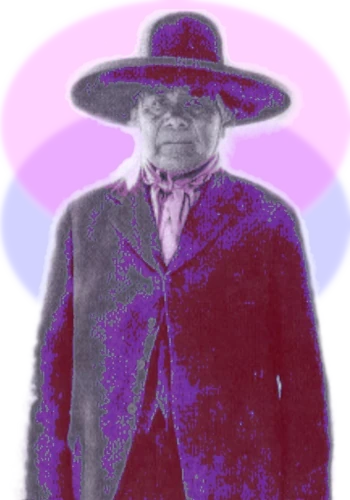
Jack (Wovoka) Wilson (1856-1932)
photo credit:
This image is hosted by the Michigan Library Online Exhibits: Great Native American Chiefs which is curated by Sherry Andrews and Michelle Jones: [lib.umich.edu] They credit the National Archives and Records Administration for the photo described as "Paiute Shaman."This photo is "a work prepared by an officer or employee of the United States Government as part of that person's official duties." This is public domain under Title 17, Chapter 1, Section 105 of US Code."--PD-Public domain.
Dee Brown describes the photo as "Wovoka, the Paiute Messiah" in Bury My Heart at Wounded Knee (1970).
hominidmedia sources:
[ Wovoka #6 ]other
Chapter eleven: "The Messiah" recounts Black Elk's exposure to the Ghost Dance.Wovoka and the Ghost Dance movement comes during a time of Indian famine caused by America reneging on the Black Hills treaty which was imposed by the Federal government. Add to that a drought, the slaughter of the buffalo and a crop failure--the natives felt powerless, "we could not eat lies, and there was nothing we could do." There is also a current of personal tragedy for Black Elk. The death of his father (and the possibility to reconnect in the new world) guide Black Elks adoption of the Ghost Dance into his own Red Hoop vision. In 1889, the "pitiful" and "despair[ing]" people were inspired by "strange news from the west." Black Elk describes Wovoka as "a sacred man among the Paiutes who had talked to the Great Spirit in a vision, and the Great SPirit had told him how to save the Indian peoples and make the Wasichus disappear and bring back all the bison and the people who were dead and how there would be a new earth." Three Dakotas (Good Thunder, Brave Bear and Yellow Breast) went west to learn more from the Oglalas. These three returning Pine Ridge Dakotas described Wovoka as "the son of the Great Spirit" known as Jack Wilson to the anglos. Wovoka promised a new world coming "like a cloud" from the west that would destroy the "old and dying" world. This new land had enough food, "all the dead Indians were alive" as were "all the bison." Then Wovoka taught the three Dakotas the ghost dance. The purpose of the Ghost Dance, to Black Elk, was to "get on this other world when it came" leaving the anglos stuck on the old world as it disappeared. Wovoka gave Good Thunder two eagle feathers and told him that the Great Spirit would use them to bring back the lost Dakotas.
Black Elk thought he could work with Wovoka, "maybe this sacred man had had the same vision and it was going to come true...[m]aybe I was not meant to do this myself..." A second expedition to Wovoka revealed that he was "really the son of the Great Spirit who was out there; that when he came to to the Wasichus a long time ago, they had killed him; but he was coming to the Indians this time..." and this millennial event would occur the next winter (1891). The legend of Wovoka grew and his powers included psychic projection and animal communication. The Dakotan version of the Ghost Dance started on the Pine Ridge reservation and Wounded Knee Creek soon after. Black Elk recounts the dance, "The dancers, both women and men, were holding hands in a big circle, and in the center of the circle they had a tree painted red with most of its branches cut off and some dead leaves on it." This reminded Black Elk of his vision and he was "feeling sad" because he "had done nothing yet to make the tree to bloom." This was how he went from being a Ghost Dance skeptic to a participant.
Brown's period starts in 1860. "In the Nevada country of the Paiutes a future Messiah named Wovoka, who later would have brief but powerful influence upon the Indians..." had just been born by the start of his history. Chapter eighteen is about the Ghost Dance. Brown starts the period in 1887 with the Interstate Commerce Commission (1887), includes the the opening of Oklahoma (1889), and a Wovoka speech. This primary source builds upon Wovoka's biblical vision: including reincarnation, invulnerability, youth, a great flood followed by a "fine time." Without any anglos around, Indians that didn't adhere to Wovoka's vision "will grow little"--a reference to their physical size not their number--some will "be turned into wood and be burned in fire".
Brown's Ghost Dance narrative starts in 1890 "about a year after the breaking up of the Great Reservation..." Sitting Bull is first informed of the dance by Kicking Bear. Wovoka had "founded the religion of the Ghost Dance." The Dakota "pilgrims" were inspired by "a [commanding] voice" that sent them to find Wovoka. They found the "Fish Eaters" near Pyramid Lake. After three days wandering in the desert "the Christ appeared." He addressed the mass, taught them the dance and they did. The next day Wovoka showed off some stigmata and informed his disciples that Christ was initially sent to "teach the people" but he was "treated...badly" by the whites. So he came back "as an Indian" in order to "renew everything" and "make it better" by levitating the Indians and replace the earth underneath them with a new land populated by game and their ghost ancestors.
The Dakotas returned to their home, accompanied the whole way by a singing Messiah. On their return, Kicking Bear started dancing at Cheyenne River, Short Bull at Rosebud, Pine Ridge and eventually Standing Rock (where Sitting Bull was) got it eventually. Sitting Bull wasn't convinced of the Dance's power but he allowed his people to dance. When the Federals came they would wear Ghost Shirts.
The Ghost Shirt is "painted with magic symbols" that protected the wearer even from bullets. They danced even after the federal edict: "Stop the Ghost Dancing."
This edict reveals the racist nature of America's Indian policy. The agents who outlawed the dance as a scary Indian phenomenon "failed to recognize the Ghost Dance as being entirely Christian. Except for a difference in rituals, its tenets were the same as those of any Christian church." Brown listed the commandments: do unto others..., be nonviolent, love each other, "the doctrine called for no action by the Indians except to dance and sing" which would bring a rebirth.
Kids stopped going to school, workers stopped showing up, farms were unworked, stores were closed--everybody was dancing in their painted shirts in the Dakota snow. The federals decided to arrest and imprison the "fomenters of disturbances" in military jail "until the matter [was] quieted." They went to arrest Sitting Bull peacefully and predictably ended in a shoot-out where Sitting Bull was killed.
Burnette's narrative starts the Ghost Dance period with "years of starvation and disease." There is more here about Wovoka's initial vision. It occured during a solar eclipse where he was "transported to heaven and met his ancestors." The period ends with Sitting Bulls funeral, a "day of ghoulish amusement" for the federals.
The difference between the Burnette narrative and Neidhardt or Brown's is in the conception of Wovoka as 'the Christ.' The former frames Wovoka as a prophet predicting the return of a Indian Christ. The later two frame Wovoka as the Messiah himself. Both describe his return as an Indian because of white mistreatment of the original Jesus.
Sitting Bull has become the focus of this narrative because the dance was "wrongly attributed" to the "somewhat reticent" Sitting Bull by "paran[oid]" federal agents including James McLaughlin. McLaughlin used the dance as pretext for assassinating Sitting Bull, sarcastically described as a "triumph of BIA diplomacy" by Burnette and Koster.
Page's book includes the previous generation of Paiute "responses to a new, restricted world." In the 1860s Wodziwob (aka Fishlake Joe) learned from a trance that his people "create a new paradise by performing certain rituals..." especially a certain style of dance: hold hands in a circle and step to the left "five nights in a row and overall twenty times a year" dead Indians would return. This version of the Ghost Dance influenced many tribes of the west.
Page's narrative returns to familiar ground: Wovoka (aka the Woodcutter) had a vision while "cutting wood for use in a Nevada Mine near the Walker Reservation." This mine was owned by Wovoka's white parents the Wilsons. During this vision, God told Wovoka "to not fight, but to work with the white man, and to dance in the manner that Wodziwob had called for." Their reward was not in this life on a new Earth (like the Dee Brown narrative) it was "in the next life." Wovoka could make rain and was "invulnerable to gunshots."
Page acknowledges the Christ versus prophet distinction from Burnette and Koster, "Wovoka apparently did not think it appropriate that some of his visitors took him for the Christ come again." There is also a difference in the naming convention: Paiutes called it the Round Dance while everybody else (including the Sioux who brought it to Sitting Bull) called it the Ghost Dance. The change from Paiute round dance to Sioux ghost dance is where Page finds another transformation. Wovoka's dance was about hard work and reward in the next life. The Sioux dance was about "the destruction of the whites, the resurrection of the ancestors, and a nativist return to the pure old ways of the tribes." This is more like Wodziwob's dance from the 1860s.
Page ends his narrative with the "attempted....arrest [of] the old chief" and the Wounded Knee Massacre which followed, "as so often had happened in these encounters through the years, shots rang out, hell broke loose, and Indian men, women, and children wound up dead in the snow...some three hundred people."
Professor Warren (UC-Davis) described the environmental roots of the Ghost Dance movement. Anglo mine expansion impacted the supply of pine nuts and fresh water. Jack Wilson (Wovoka) had a spiritual experience--passed out and had a divine experience which combined indigenous shamanism and Christian ideology. In his trance Wovoka learned sacred revivalist songs from God. He brought these back to the Paiute. The Ghost Dance involved singing and dancing for long periods of time. It spread from the Paiute in Nevada to other native tribes such as the Lakota-Sioux in South Dakota. The feds and SoDaks interpreted it as a "war dance" which led to "panic and hysteria over an Indian uprising" in the Pine Ridge reservation. One of the resulting massacres was at Wounded Knee.
Treuer described the evolution of the Ghost Dance. Wovoka's original vision stressed peace among Indians and with whites, hard work and sobriety. When the Lakota received the dance "it had taken on a more millennialist flavor..." by executing the dance correctly its followers could find peace in a traditional world without white people. This inflamed the federal paranoia and they broke up the great reservation into five chunks "so that the Indians would have a harder time gathering..." Some other pressures included missionaries, allotment (the privatization of communal Indian land), the removal of Indian children for reeducation. Eventually they outlawed the Ghost Dance. McLaughlin was scared that Sitting Bull would combine his personal notoriety (earned at Little Big Horn) with the Ghost Dance fervor to end the peace of 1881. That's why Sitting Bull was to be arrested and instead was killed.