WI drama:
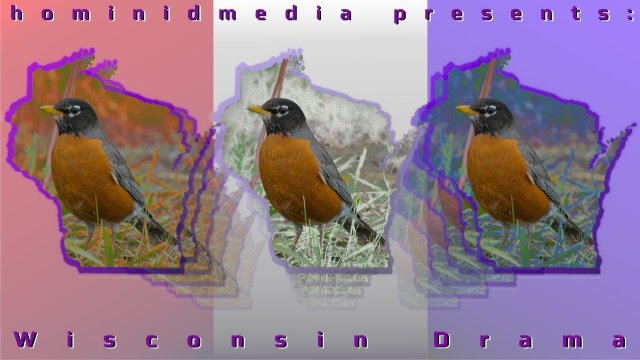
Crowley's Little Red Bird
Today is the Wisconsin Democratic Primary. David Crowley is one of the candidates for governor. His a Milwaukee city executive from the west side. He suspended his 2026 campaign when Lieutenant Governor Sara Rodriguez consolidated the right wing of the party against DSA-er Francesca Hong. Rodriguez' accounting troubles caused her to withdraw and Crowley now had a lane to win the primary. Crowley was lobbied by centrist Wisconsin Democrats, including incumbent Governor Milquetoast Tony Evers, to rejoin the race. This is a pragmatic and predictable act for a man who wants to be governor to take with the support of the establishment his party.
For some reason, Crowley went on a radio show and made up a fantastic story about God telling him to re-enter the race. [1] This idealist nonsense should not be part of politics in the twenty-first century. This man should not be allowed effect school policy or health care with his nonsensical vision of material reality. What's arguably worse is the story--about God sending a red bird to tell Crowley's wife that he should re-enter the race--was probably lifted from a contemporary Steven Spielberg movie. [2]
Materialism is a better way to choose leaders than divine symbols. That doesn't mean politicians don't still claim divine imprimatur. Prioritizing material reality over idealism is the only way to understand and progress life in Wisconsin. Voters have the ability to determine who has the best understanding of their physical surroundings and who literally talks to a personification of his own psyche as it were a divine entity who talked back.
-----
Some rich city folk moved into the brand new lakehouse nextdoor about fifteen years ago. Every year they come up for a few weeks and email every one of their neighbors trying to buy part of all of the neighbor's property and expand the footprint of their estate. Once in a while us older neighbors wonder, "Why are these rich people so bothersome?" There is a materialist answer among idealistic and judgmental ones.
The idealistic reasons lead to idealistic actions. For instance, environmentalists see the encroaching of these city people, their behemoth houses and destructive wake boats as potentially an existential threat to nature. Their anti-social actions are accepted by the rural folk in exchange for some of their vast wealth that could only be accumulated in the city. The old timers have dealt with all sorts of invasive species. We have heard stories about DDT, seen the phosphorus blooms and read about mercury warnings in the fish stock. We've seen the devastating photos from the clear cut and heard stories about being able to see Rhinelander from Sugar Camp because there were no trees left.
These new neighbors are soon to level and rebuild their summer party home--which to old timers still seems brand new--and the trees won't grow back there for another generation. Environmentalists of the neighborhood are offended by the development and band together in associations to gossip about their memories at meetings. While the lake group drinks coffee and talks about Eurasian Milfoil and Curly-Leaf Pondweed the nouveau (and) riche stir up the sediments and transport bilge water. But at these same meetings the environmentalists promote industrial era human interventions such as weed harvesting, gasoline-powered boats and (modestly) developed lake shores without irony. Without the weed harvester, the lake wouldn't be navigable. The boat problem would resolve itself. People would stop building too close to the shoreline. Say the environmentalists, "This is a wonderful course of events!" Property values would plummet. The green environmentalists are turned pragmatic gray by this last part and abandon the whole endeavor. In return for our natural surroundings we receive tax revenues (schools and roads), seasonal boutiques (the startup of vacationland) and the security of property values inflated beyond other rural areas. The green-capitalist's concession shows the material connection between the environmentalist belief in the existential threat of development is undermined by a belief in moral free markets which allows anti-social acts like conspicuous consumption and wealth accumulation.
A materialist understands the inevitability of development under the capitalist paradigm and knows laws, rules and mores will not keep the rich folk from flooding in from the cities and building tiny little Lincoln Parks or Joliets in Oneida County. An environmentalist who recognizes this understands there is no way to stop the eventual development, commodification and consumption of every last piece of nature on Earth without first addressing the basic root cause: the dominant political economy of capitalism. Of this, the acquisitional neighbor is an inevitable stage. Idealist conceptions such as conservation, community cohesion, inter-generational settlement and tradition (sung like Tevye the Dairyman) are superstructures sitting atop a capitalist base.
To understand the "the horror" of settler imperialism from within the colony is an inquisition as old as imperialism. To understand Vietnam, Francis ford Coppola adapted Joseph Conrad's "Heart of Darkness." The modern adaptation would frame Kurz driven insane at the edge of the imperial frontier (to Conrad a colonial agent for an ivory company; to Coppola a colonel for an invading army) as a real estate agent driven mad by the sounds of chainsaws, leaf blowers and heavy equipment backup beepers. This is not as haunting if it is seen as part of the inevitability of development. For us, "[t]he earth for us is a place to live in, where we must put up with sights, with sounds, with smells, too, by Jove!--breathe dead hippo, so to speak, and not be contaminated." [3] If this is material reality then we must use material methods to change it--not wait for God to send us birds to tell us the status of the flood.
-----
This political economy impacts the neighborhood. About twenty-five years ago the seasonal people from Madison who owned the cabin next door had two kids approaching college age. To pay for this, they parceled off a sliver of forest and swamp next to the cabin. Being neighborly, they offered it to us under listing before it went on the market--at the time some $20,000. This money would pay the kids' college tuition. And they could keep the cabin on the lake.
Over the next years, on that tiny postage stamp we watched a comparative mansion arise, custom built, between our two story modular home and their four room fishing cabin. On weekends the kids would wander through the construction site and marvel at the woodwork and fixtures. This was once a forest where they had made forts along a deer path under massive white pines. Now it was an alcove tiled for a Jacuzzi. The house was too big for the property--which expanded by filling in a wetland and liberally interpreting the property lines to squeeze the whole thing in. The kids went to college, the realtors and developers took their percentage and our new acquisitional neighbors moved in.
Ever since it has been an onslaught of expanding docks, new boats--jets, wooden, jet-skis--, construction machines importing boulders from down south and moving them onto the the shoreline--doing the work of glaciers--, so called "mosquito police" spraying all sorts of poisons into the trees, air and water. There is seemingly noting about this place that the property owners didn't want to alter. Even the nightly music of nature was soon drowned out by electronic nonsense cranked so loud it could be heard across the lake in between construction noises and all terrain vehicles. This is all their private property right and it is an important part of the local economy. These outsiders must employ half of the Lakeland High School junior class for maintenance, dock expansion, window cleaning and grounds crew. The other half wait on their tables, muddle their drinks and charbroil their steaks. Their luxurious lifestyle of the seasonal residents is not likely for anyone of the service workers employed by the city folk.
The result of this economic imbalance between townies and tourists was not a gestating class consciousness leading to a predictable increase in the compensation and material well-being for everyone. Instead, the local capitalists have for decades imported seasonal labor from the poorest countries in the world paying minimum wage and in potentially coercive relations that control housing, transportation and visas. These acquisitional neighbors on the lake actually provide a reliable place for the locals who own the means of production (lawnmowers, trailers and trucks) to work. This is vital as they are being undercut in the rest of the seasonal service industry by undocumented, prison and child labor--all of which pay below minimum wage (two of which are state sanctioned). Local laborers are still unlikely to earn enough to buy one of the lakeside properties they service because they are bidding against portfolios maintained by big-city financial types like David Crowley.
In the fifteen years that the acquisitional neighbors have been around our only contact has been to inquire about purchasing or parceling the land on our boundary that is still forest on one side and has timber on the other. This is uncouth and unneighborly around these parts but totally normal in the realm of urban capitalist relations. The land is a commodity and a person with a much larger portfolio is interested in its acquisition. In a different setting, like a stock sale, constant inquiries may signal interest and seem less personally galling. The material reality of capitalist relations struggles to commodify the emotional implications of a land deal. It is even harder to explain to settlers why they just can't take something being held by a person of lower status if that's what they fancy. People with portfolios don't hear "no" and are untrained by it's utterance. They make up reasons why an object they desire should be in their possession. Claiming divine sanction for unpopular or anti-social acts is (presumably) one of the oldest tricks in the Rules of Acquisition.
-----
Now it is time for our rich neighbors to to build a newer and bigger house on their tiny hill and converted swamp. They are confused why their footprint hasn't grown as fast as their to meet their desire to develop. Their old neighbors, like me, are obstructionists who impede their personal progress and might even hurt the local economy. Every other piece of property on this part of the lake is now a rooming house (renting for thousands of dollars a week with absentee landlords paying people from the Reservation to clean their toilets) or of speculative investments balancing out the Raytheon stock managed by a Wrigleyville Patrick Bateman (Deep Dish Gordon Gekko?). There are still plenty of people who use the lake to ski and fish but the escalating size and scale of the boats and their wake is out of control even of the cadre of concerned citizens who meet at the Town Hall.
An idealist looks at this situation and believes there is some middle point between the orgy of human consumption and Aldo Leopold's uninterrupted cottage-less nature. To an idealist, all a community needs to do to protect their surroundings is write good rules and enforce them. This is a gross misunderstanding of history that doesn't factor in the ecological destruction possible during a political distraction or short term dalliance with fascism. For the right price, earth movers can turn a National Park into logs and barrels before even the most vigilant community can mobilize. There is no limit to the circumvention, obfuscation or violation that capitalism can buy.
As the pieces of lake without city-baron palace-cabins on them dwindle, the value increases of each piece without some gaudy place to park and launch seasonal adult toys. That also means the reward for selling-out the family farm (so to speak) will continue to increase. This reward will be supplemented by state sanctions that benefit the biggest taxpayer. If old timers refuse to sell or parcel their land concepts like eminent domain and manifest destiny will begin to develop. There is nothing that will stop the settlement from coming up here and destroying what we have made. After all, its what we did to the Ojibwe and Menominee who were here before we acquired the land. Our tactics were so much worse than any underhanded realtor, unscrupulous surveyor or unabashed consumer.
The reason these thick portfolio-ed acquisition-al neighbors are now nipping at our proverbial heels is because the middle class summer people from Madison needed money to pay for their kids college. They didn't want to sell their forest and spend summers at the lake under some vainglorious towering party home blasting techno music while vroom-vrooming around the old fishing hole in hundred-thousand dollar wake boats. No one wants that. Other then the Tom Wolfe styled "hypomanics" [4]: adolescent goobers spending as much money on recreation every idle drunken summer as their sweaty and callused hired hands make in a decade.
-----
The only way to keep development minded people from their unsavory raison d'etre is to change the underlying economic structure that allows, encourages and even rewards those who keep coming here and mowing down the trees, poisoning the water and polluting the air. To expect local mores to prevail is ahistorical. To expect the manifestation of some divine power is immaterial. A century and a half ago, the Dakota were confronted by a similar plague--the one that my great-great grandfather rode to Oconto County from Moravian Bohemian Austria (or thereabouts). To inspire divine intervention they danced until collapsing. To drive out the invaders--people like me--they pierced their flesh with hooks and hung from trees. When they rode into battle against the Federales they wore magic shirts that protected them from bullets. These tactics wouldn't serve us any better today in this invasion of city-folk than it did the indigenous that were trying to drive out my people when they were homesteaders. Appeals to the natural environment or community decorum will as futile as appeals to the Great Spirit seem a century from today. We might as well be divining God by birdwatching, like David Crowley does.
The only way to stop acquisitional neighbors from colonizing that which you think is yours is by changing the material conditions that allow and reward such an anti-social attitude to exist. Anyone who lives in the periphery who doesn't understand the material precarity of their existence will be surprised when they are dispossessed, evicted or third-world-ized. It is inevitable in this material reality.
This certainty is actually calming to Marxists. As the dispossession increases in speed and depth it will result in a group of people who are forced by their diminished material well-being to develop class consciousness. This class will increase in size and own less while the owning class will get smaller and own more. Eventually the contradiction between democracy and oligarchy will overshadow any pretense of republicanism. The resulting class consciousness replaces the republican dictatorship of the bourgeoisie with the democratic dictatorship of proletarians, etc...
In the northwoods, as part time oligarchs out-price labor's ability to live there, no one will be left to pump septic tanks and cook their dinners. When this has happened in other parts of the service sector, local capitalists imported labor from overseas every summer--these economics are changing as the American economy deteriorates. Organizing workers babbling different languages, working on company sponsored visas for a five month season is unlikely. The class consciousness that developed in the dispossessed townies is not likely to be recreated in transient workers either--these are kids who've went to school together sometimes for generations. The model for organizing this new class of imported labor is probably more like the United Farm Workers than an industrial model of service workers. But the economics will make it unprofitable as America becomes more "third-world" compared to the developing south.
Wisconsin's governor will manage the state's economy during the next six years of the nation declension. There is little they can do with the previous decade of national bipartisan catastrophe. Their policies, appointments and recommendations will exist within the international context of the ending American hegemony. This is not an enviable position for business as usual. The potential Republican candidate "Youbetcha" Tom Tiffany is from the northwoods and is in favor of unregulated development, the privatization of the commons, Trumpist (read in Wisconsin as: Tommy Thompson-esque) domestic austerity and hyper-masculine sovereignty. This open for business policy, brought to you by the Wisconsin Manufacturers and Commerce and Tavern League lobbies, will increase the flow of acquisitional neighbors up north . From Tiffany's point of view, this development will have a positive economic impact and is therefore worth development--even of the reservoir (read in Wisconsin as: flowage) system that he used to manage.
Wisconsin Republicans are willing to trade the liberalization of their body politic and the total consumption of their natural resource in exchange for short term economic gains and perhaps a ticket out of Kinshasa, Saigon, Hazelhurst. There is no left leaning materialist who should support this unless trying to accelerate the inequality endemic to the region and increase economic disparity.There is an apocryphal quote that Marxists adapt for this type of thing, "the capitalists will sell us the rope with which we will hang them." Thankfully, increasing the tensions of contradiction to a potentially violent breaking point is not the only way to address the problem of unregulated development. But we do need a materialist to lead the state through this transition over the next six years.
Democratic gubernatorial candidate David Crowley, the guy who believes God talks to him using cardinals, is a financial manager from Milwaukee. His personal experience and idealist worldview make him unlikely to sympathize with northwoods citizens or conservationists statewide. He is so out of touch with nature as to believe one of the most common and visible birds in neighborhood backyard is actually on a singular mission from God. More probable is this divine signal reinforced his psychological desire to amass power, or echoed political pressure from centrists to beat Hong, or embodied his racial community's expectations for role models, or (most probably) his own economic self interest.
Under these conditions his wife is right to have talked him into reentering the race in any way she could. If he believes in meaningful birds then she is right to press her nightingale bosom onto the thorn of a white rosebush and warble her little heart out. The voters are better advised to realize that in the material world Love truly is a "silly thing...not half as useful as Logic, for it does not prove anything, and it is always telling one of things that are not going to happen, and making one believe things that are not true." Instead, may I suggest a Third Party caucus caucus with the Greens? [5]
There is nothing wrong with a romantic using metaphysics to understand their rational choices and material well-being. But, these supernatural beliefs are not really suited for liberal government. Whats worse is an outsider who feigns mystical visions to fit in with the townsfolk. In this manner, anything could be used at any time as a symbol to expedite unpopular politics as if it were the divine plan.
Progress is inevitable. Executives that understand material reality are better suited to deal with it than those who understand the physical world as a intelligent design (or worse, the free market). Metaphysicians are not grounded in reality by definition. Development is also inevitable. To influence the nature of that development an executive must define the fundamental character of exchange in a way that considers different factors than portfolio, reputation and entourage. Nature, labor and peace must be the the basic units of this exchange if we hope to survive to see another election in six years.
notes:
[1] hominidmedia's transcription of David Crowley's video interview (uncredited) which was posted by independent journalist Ken Klippenstein on (8 August 2026) [link] :
"So actually...me and my wife prayed on it. And my wife...she said during the prayer she said, "God, I don't like subtlety, so make it very obvious." She actually asked, like red bird and was like very specific, right?
"So Thursday come around and we're still getting phone calls [from centrists trying to get him to re-enter the race] and my wife is actually answering my phone and saying, "We're done! We're not doing this, okay?"
"Because, if she's not there I'm absolutely not...Friday morning comes...and I'm getting all of these phone calls..."
"But my wife [who works for a homelessness focused NGO called "Community Advocates"] was setting up for an outreach. And as she was setting up her outreach table, what does she see? She sees the red bird. She's not even thinking about it. Not even two minutes later she gets a phone call that is informing her about the Lieutenant Governor [Rodriguez] dropping out [after misplacing hundreds of thousands of dollars in campaign contributions].
[2] Disclosure Day (2026) was still in theaters when Crowley gave the interview. Part of the advertising campaign for this movie was a series of billboards featuring a mysterious red bird. The movie is about alien conspiracies. A quote:
"I was in bed and I dreamed that something was watching me. I woke up and there was this bird..."
"It was a cardinal."
"...in the window and it looked at me and after that everything just changed. I saw things, context, patterns, artifact-ing. I could see it all..."
[3] Joseph Conrad Heart of Darkness New York: The Modern Library, 1999 pg. 60-1.
[4] A Man in Full (1998) is Wolfe's second novel. There is a scene in this book about southern masculinity where rich douche bags project pornography on the sails of their yachts during a bacchanal in the South Florida sea. One of the boats is named "hypomania" after the seemingly pleasant mental state of agitation between status quo and full on hyper-mania. This is the state of confused ecstasy and orgiastic consumption that you see on the lake in Wisconsin's northwoods in summer. It is families non stop tube rides, or sunburnt teens on party pontoons, or competitive anglers wearing Ranger branded clothes, or the Nautique skiers strafing peoples docks to make the lake bigger, or wooden boat antiquarians with look-at-me Harley-Davidson inspired exhaust pipes and bikini riders who charge by the hour.
[5] This is a tortured reference and direct quote from another romantic-tragic bird story: Oscar Wilde "The Nightingale and the Rose" (1888).